Long Call, Long Put, Covered Call — with real numbers
Why a few hundred dollars of premium can control $10,000 of stock exposure — and where the risk still sits. Written for absolute beginners.
Long Call — the simplest bullish option
A long call gives you the right (not the obligation) to buy 100 shares of a stock at a fixed price (the strike) before a fixed date (the expiration). You pay a price for that right — the premium.
You only need the stock to rise enough so that the gain in the option covers what you paid. Your maximum loss is the premium you paid. Your potential gain is theoretically unlimited if the stock keeps rising.
At expiration if stock is $110: intrinsic value = $5 → profit = ($5 − $3) × 100 = +$200.
If stock stays below $105: option expires worthless → max loss = $300.
Payoff Diagram and Calculations
This picture shows what happens to your profit or loss at expiration depending on the stock price. Everything left of the strike is a flat loss (you lose the premium). Once the stock is above the strike, the line rises. You break even when the stock reaches strike + premium.
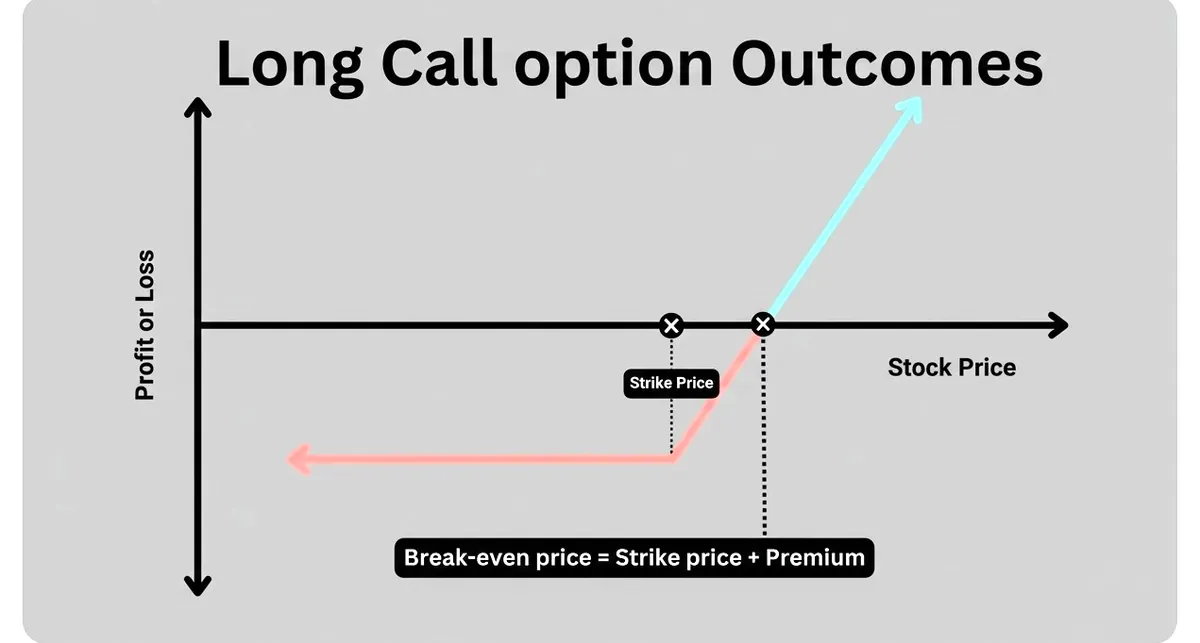
| Stock at expiry | What happens | Rough P/L (1 contract) |
|---|---|---|
| Well below strike | Option expires worthless | − full premium |
| Exactly at strike | No intrinsic value | − full premium |
| Strike + premium (break-even) | Intrinsic equals what you paid | $0 |
| Well above break-even | Intrinsic > premium | Profit rises $100 for every $1 the stock rises |
Call Options and Moneyness
Moneyness simply answers: “Is the strike already profitable or not?” It tells you how much of the option price is “real” value versus hope value.
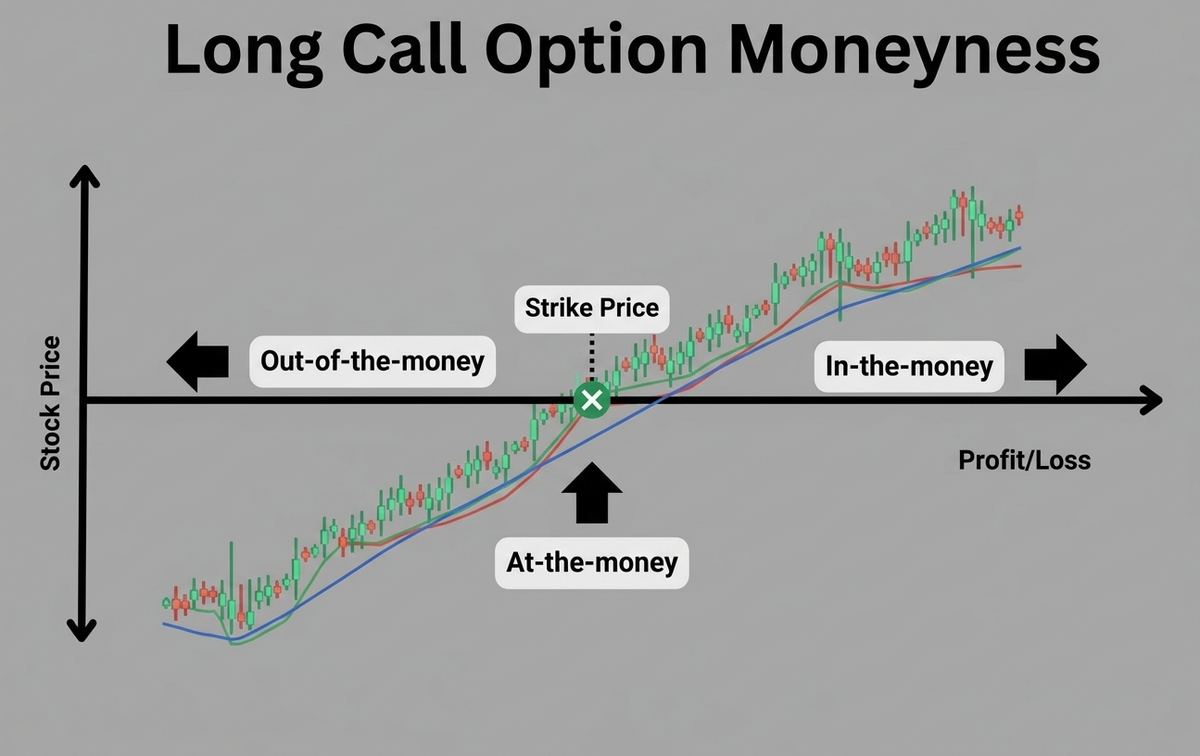
- In-the-money (ITM) — Strike is below the current stock price. The call already has some real (intrinsic) value. Higher price, higher probability of finishing profitable, higher delta.
- At-the-money (ATM) — Strike is roughly equal to the stock price. Almost all of the price is time value (extrinsic). Highest sensitivity to big moves (gamma) and to time decay (theta).
- Out-of-the-money (OTM) — Strike is above the stock price. Cheap, only time value. Needs a bigger move to become profitable. Lower probability, lower delta.
When a Long Call can make sense
- You are strongly bullish but want a defined maximum loss (you can’t lose more than the premium).
- You want leverage — control 100 shares for a fraction of the stock’s cost.
- You expect a big move soon (earnings, product news, etc.) and accept that timing matters.
- You expect volatility to rise (long calls benefit when implied volatility increases).
The big catch: time decay (theta)
A long call is a wasting asset. Every day that passes (with the stock and volatility unchanged) the option loses a little value. Near expiration the decay speeds up. Even if the stock goes up a little, the option can still lose money because of theta and possible volatility crush.
Long Put — how it really works
A long put means you buy the right to sell shares at a specific strike price before or at expiration, depending on the contract. You normally buy a put when you believe the underlying will fall. Unlike shorting the stock, the maximum loss on the option itself is limited to the premium paid.
You pay $2.50 per share for the right to sell at $95. At expiration, the put's intrinsic value is
max($95 − stock price, 0). Your expiration P/L is that value minus the $2.50 premium.
Long Put expiration outcomes
| Stock at expiry | Put value | P/L per share | 1 contract |
|---|---|---|---|
| $110 | $0 | -$2.50 | -$250 |
| $95 | $0 | -$2.50 | -$250 |
| $92.50 | $2.50 | $0 | $0 |
| $80 | $15 | +$12.50 | +$1,250 |
| $50 | $45 | +$42.50 | +$4,250 |
What happens as the stock falls?
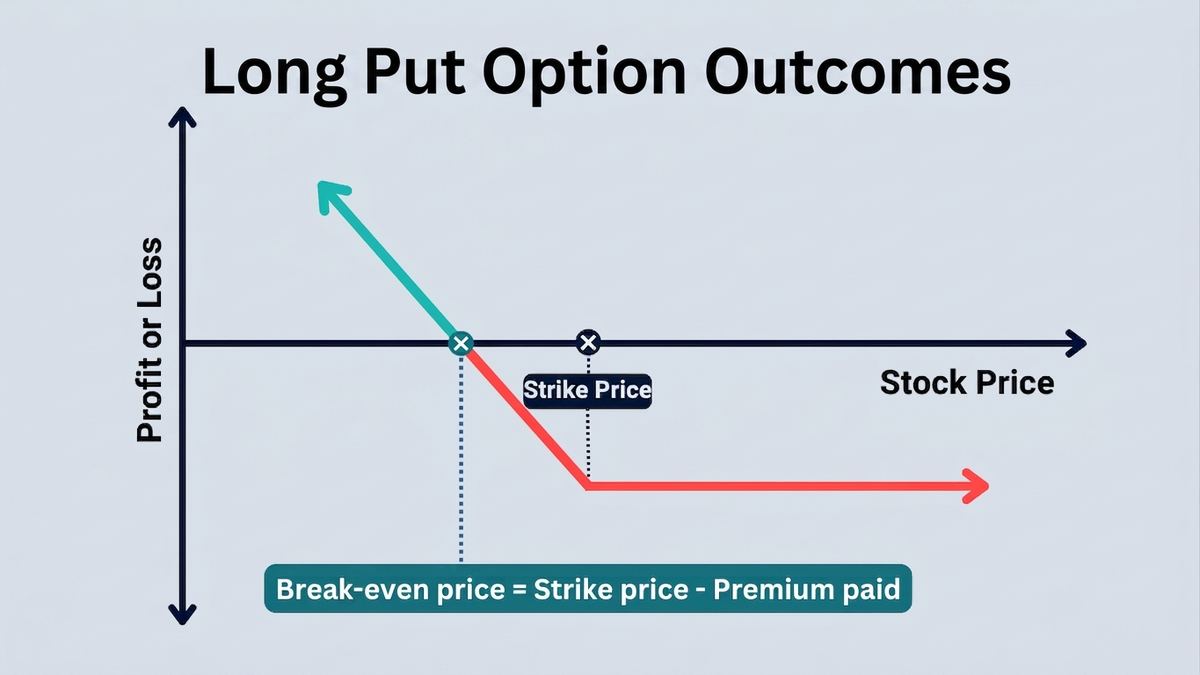
Below the strike, the put gains intrinsic value dollar-for-dollar as the stock falls. But remember: your premium must first be recovered.
Put moneyness: ITM, ATM and OTM
For a put, the relationship is the reverse of a call. A put is in the money (ITM) when the stock is below the strike, at the money (ATM) when the stock is around the strike, and out of the money (OTM) when the stock is above the strike.
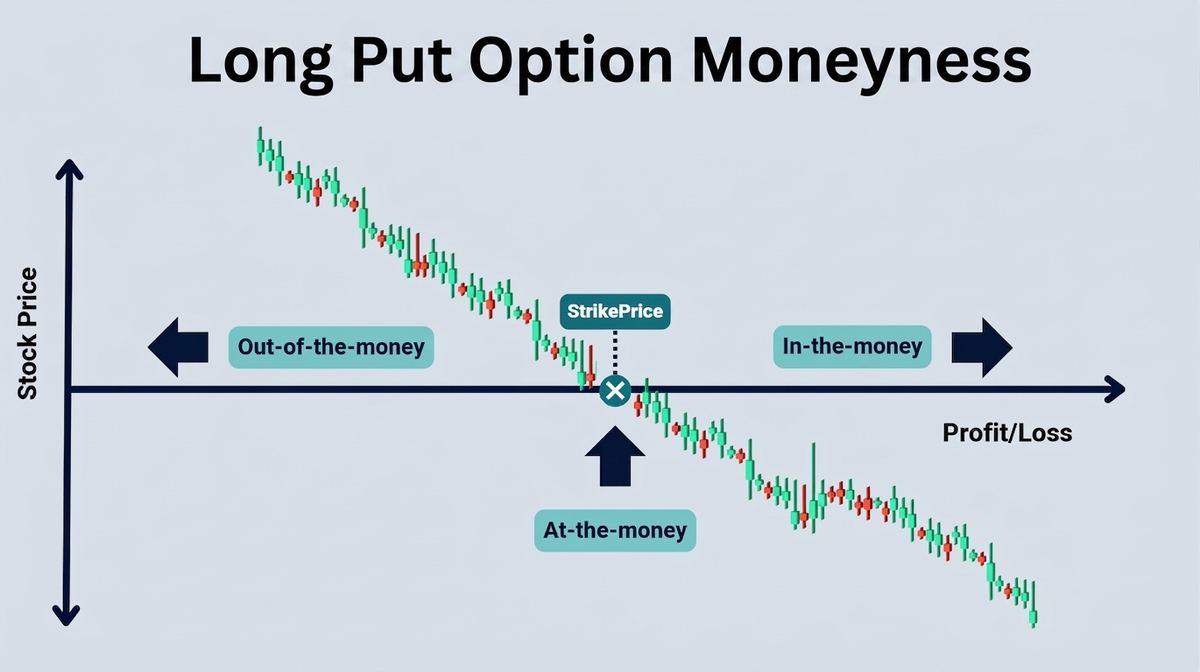
- ITM put — stock is below the strike. The option already has intrinsic value.
- ATM put — stock is near the strike. It has little or no intrinsic value, so much of its price is time/extrinsic value.
- OTM put — stock is above the strike. It has no intrinsic value at that moment and needs a decline to become more valuable.
When can a Long Put make sense?
- You have a bearish view and expect a meaningful decline.
- You want a defined maximum loss instead of taking potentially larger losses from short stock.
- You want downside exposure with less upfront capital than buying 100 shares of stock.
- You are using the put as a hedge against an existing stock position.
The big catch: timing matters
Buying a put does not automatically make money just because the stock eventually falls. The stock needs to fall enough, and ideally soon enough, to overcome the premium paid and the effects of time decay. Implied volatility can also change the option's market value before expiration.
Long Put
Gives you the right to sell 100 shares at the strike. You profit when the stock falls enough to cover the premium you paid. Max loss is still only the premium.
At $80: ($15 − $2.50) × 100 = +$1,250.
Covered Call — collecting “rent”
Own 100 shares. Sell a call against them. You keep the premium. If the stock stays below the strike you keep the shares + premium. If it rallies past the strike, the shares can be called away (you sell at the strike). Upside is capped; downside on the stock remains.
- Often used when you expect flat to mildly up price action
- Does not eliminate loss if the stock crashes
Covered Call — collecting “rent” (deep dive)
A covered call is one of the most popular income strategies for investors who already own stock. You own (or buy) 100 shares and sell one call option against those shares. The call is “covered” because you already hold the shares you might have to deliver if the option is exercised.
Think of it like collecting rent on a house you own: you receive cash (the option premium) for giving someone else the right to buy your shares at a set price (the strike) by a set date. You keep that cash no matter what happens next.
When traders use it
- You are neutral to mildly bullish — you expect the stock to stay roughly flat or rise only a little.
- You already like the stock and plan to hold it, but want extra income while you wait.
- You have a target selling price in mind and are happy to sell at that higher strike if the stock gets there.
- You want a small buffer against modest declines (the premium lowers your effective cost basis).
Key numbers (using the example)
- Premium collected: $2 × 100 = $200 cash right away.
- Breakeven: Stock cost − premium = $100 − $2 = $98. The stock can fall $2 before you start losing money relative to just holding the shares.
- Maximum profit: (Strike − stock cost) + premium = ($110 − $100) + $2 = $12 per share ($1,200). This is locked in once the stock is at or above the strike at expiration.
- Maximum loss: Theoretically stock cost − premium = $98 per share if the stock goes to zero. The premium only cushions a small drop; it does not protect against a big crash.
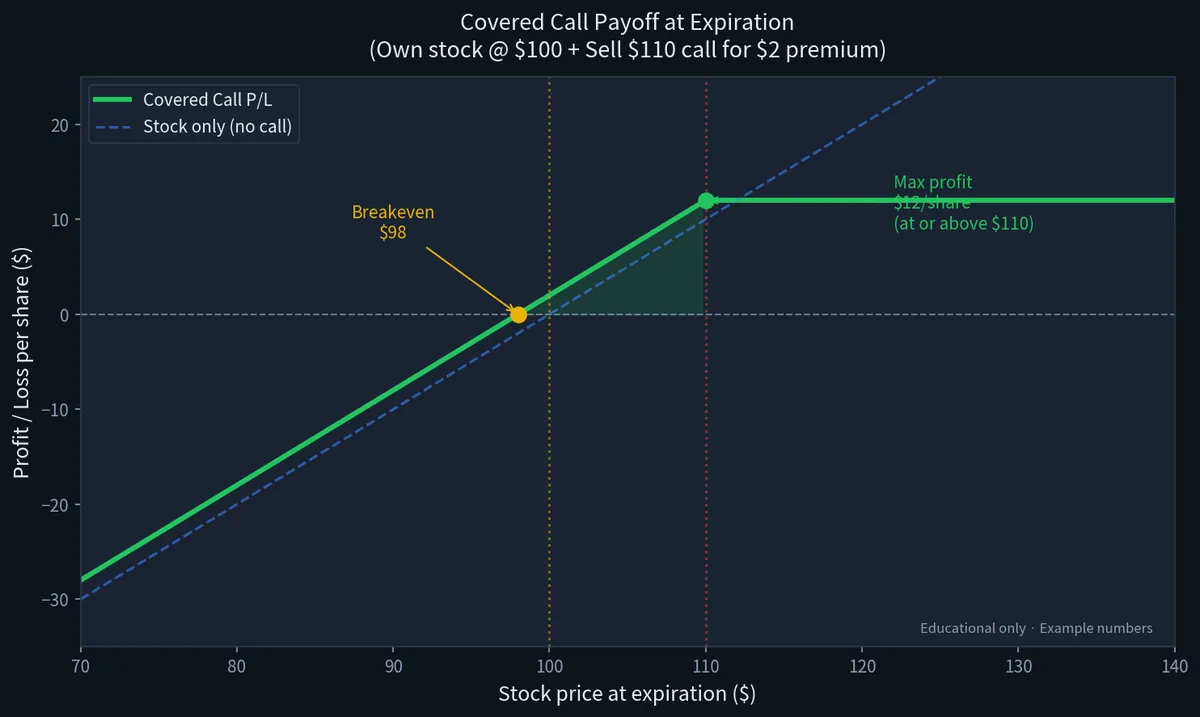
Covered call outcomes (example)
Own 100 shares at $100. Sell a $110 call for $2 → $200 credit.
| Stock at expiry | Call result | What you keep / sell | Approx. P/L vs. $100 cost |
|---|---|---|---|
| $90 | Expires worthless | Keep shares + $200 premium | Stock −$10 + premium $2 = −$8/share |
| $98 | Expires worthless | Keep shares + $200 premium | Breakeven (stock −$2 + premium $2) |
| $105 | Expires worthless | Keep shares + $200 premium | Stock +$5 + premium $2 = +$7/share |
| $110 | At the money / may be assigned | Sell at $110 or keep + premium | Max profit zone starts → +$12/share |
| $120 | Likely assigned | Shares called away at $110; keep $200 premium | Capped at +$12/share (you miss the extra $10) |
The two main trade-offs
- You give up big upside. If the stock rockets past the strike, your profit is capped. The call buyer gets the shares at the strike; you keep only the premium plus the gain up to the strike.
- Downside is still mostly yours. A $2 premium does not protect against a 20% or 30% drop. Covered calls are income strategies, not hedges. For real downside protection you would need something like a protective put or a collar.
Why everything is ×100
One standard equity option contract multiplies by 100 shares. A $3 quote is about $300 cash. The Builder always uses this multiplier so P/L matches what you see at a brokerage.
Intrinsic, extrinsic, and time decay
Review from Basics: the option’s market price (premium) always splits into two parts.
- Intrinsic — value if exercised right now. Call: max(stock − strike, 0). Put: max(strike − stock, 0). This is the “real” part.
- Extrinsic (time value) — the rest. It prices remaining time, expected movement, and demand for that option. It is not free; it usually shrinks as expiration approaches.
Numeric check: Stock $105, $100 call trading at $7.50 → intrinsic $5, extrinsic $2.50. At expiration with the stock still at $105, that call is worth about $5 — the $2.50 of time value is gone.
Time decay (theta) is that daily erosion of extrinsic value. For a long call or put, theta is usually a headwind: the clock works against you. For a short premium position (for example the short call in a covered call), that same decay can work in your favor if the stock stays well behaved.
Risk notes beginners skip
Implied volatility (IV)
High IV makes options more expensive. Buying premium into a high-IV event (e.g. earnings) can lose even if you get the direction right, if IV collapses after the event (“IV crush”).
Earnings & events
Big moves and IV changes cluster around earnings. Educational examples ignore gaps; live markets do not. Size smaller around known events until you understand the risk.
Early assignment
If you sell an option, you can be assigned before expiration — more often when a call is deep ITM near an ex-dividend date, or a put is deep ITM. Long options: you choose when to exercise.
Greeks in plain English
The Builder shows live Greeks. Here’s what they mean for a position (not just one option):
- Delta (Δ) — approx. dollar change if the stock moves $1. Positive ≈ bullish bias; negative ≈ bearish. A long call delta of 0.40 behaves roughly like owning 40 shares.
- Gamma (Γ) — how fast delta changes. Highest near the money and near expiration. High gamma means P/L can accelerate quickly.
- Theta (Θ) — expected dollar change per day from time alone (mostly extrinsic melting). Long options usually show negative theta (decay hurts you). Short premium often shows positive theta.
- Vega (ν) — dollar change if implied volatility rises 1 percentage point. Higher IV usually lifts extrinsic value; long options usually like that, short options usually don’t.
Beginner FAQ
Click any question to open the answer.
What is the most I can lose on a long call or long put?
The premium you paid (plus commissions). That is the defined maximum loss. Once the option is bought, the broker does not ask for more money even if the stock moves against you.
Why does my call lose value even when the stock goes up a little?
Two common reasons: (1) time decay (theta) — the option loses a little value every day; (2) implied volatility fell (vega). A small stock rise may not be enough to overcome both effects, especially near expiration or after a big event.
What does “break-even” mean for a long call?
At expiration, break-even is simply Strike + Premium paid. The stock must be above that price for you to have a profit. Before expiration the option still has time value, so the actual market price can be higher than intrinsic value.
Should I buy ITM, ATM, or OTM calls?
There is no single best answer. ITM costs more but has higher probability and behaves more like stock. OTM is cheaper but needs a bigger move. ATM sits in the middle and is most sensitive to both big moves and time decay. Many beginners start with slightly OTM or ATM for lower cost, then learn how probability and delta change.
How is a covered call different from a long call?
A long call is a pure bullish bet with defined risk (premium only). A covered call requires that you already own 100 shares; you sell a call against those shares to collect premium. You keep the premium if the stock stays below the strike, but your upside is capped and you still take the full downside of the shares if the stock falls.
Do I have to hold until expiration?
No. You can sell the option any time before expiration (as long as the market is open and there is a buyer). Many traders close early to lock in a profit or to cut a loss before theta accelerates.
What does “one contract = 100 shares” really mean for my money?
If an option is quoted at $2.50, one contract costs $2.50 × 100 = $250 (plus fees). If the option later trades at $4.00, the position is worth $400. The P/L is calculated on that 100-share multiplier. Always check the total debit/credit, not just the per-share quote.
Is options trading a way to get rich quickly?
No. That expectation is one of the fastest ways beginners lose money. Options can amplify both gains and losses. Sustainable learning looks more like: small position sizes, defined risk where possible, and improving decision quality over months and years — not doubling an account in a week.
What does “less is more” mean for beginners?
Trade fewer contracts, fewer strategies, and fewer simultaneous ideas. One well-understood long call or covered call is more educational than five overlapping positions you cannot explain. Smaller size also keeps emotions quieter so you can learn from the outcome instead of chasing a recovery.
Is this financial advice?
No. Everything on this site is educational only. Options involve substantial risk of loss and are not suitable for every investor. Always do your own research and consider speaking with a qualified advisor before trading real money.
Next: defined-risk spreads
Vertical spreads and iron condors — why many traders prefer a known maximum loss on both sides.